Growing up in rural Maryland in the 1960s, while hunting, I frequently encountered abandoned farms and homesteads due to the encroachment of housing developments brought on by the post-World War II baby boom. Often, their structures were virtual time capsules and contained artifacts left in place by the previous owners.
 To the chagrin of my friends, I would frequently spend more time exploring these buildings rather than beating the bushes for a rabbit or covey of quail.
On one of my forays, I discovered a United States Army guidon (unit identification flag) with two crossed rifles and the number 115 stitched upon its tattered and moth-eaten navy-blue background. For over 60 years, I thought nothing of it, but something inside of me told me to retain it.
Recently, through a chance meeting with the director of the 29th Division Museum, I mentioned what I had found decades ago, and his eyes lit up. He responded, “Do you know what you have?” I responded, “No, but please enlighten me.”
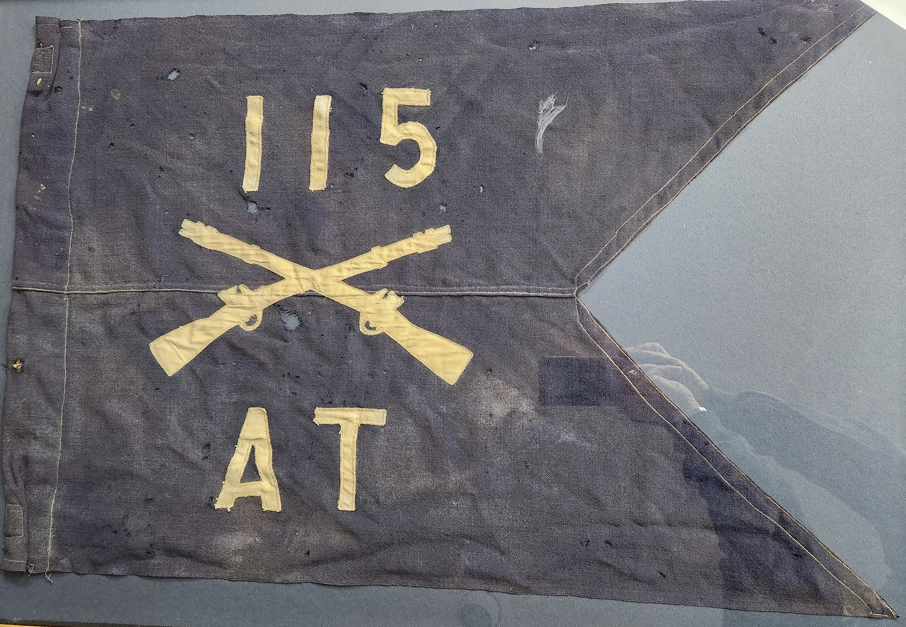
As it turns out, I had in my possession the guidon of the 115th Maryland National Guard Regiment, which was composed of citizen soldiers much like the famous Bedford Boys mobilized at the beginning of World War II. Its soldiers directly reflected rural Maryland; most were farmers and Chesapeake Bay watermen, like my family.
As the museum director pointed out, I had in my possession an artifact that more than likely was carried in the second wave of the assault force that landed on the bloody beaches of Omaha Beach. Here, the 115th experienced horrendous casualties. In recognition, the regiment was awarded a Presidential Distinguished Unit Citation.
In late August, the 115th moved with the rest of the 29th Infantry to assist in the siege of Brest, France. The city surrendered on Sept. 18, and the regiment then moved to Maastricht, Holland and participated in the final campaigns in Germany. The strength of the regiment was 3,327 on June 6, and it suffered nearly 5,800 casualties between D-Day and Dec. 31, 1944 — a heavy price to pay by everyday “citizen soldiers” who were previously farmers and fishermen — a price paid for the freedom we enjoy to this very day.
My guidon, which sat for years in a storage box, was an artifact that symbolized the determination and heroism of those who fought to defeat the scourge of Nazi Germany.
Yes, history has come full circle in that my barn find now resides in a place of honor while on display in the 29th Division Museum, where it serves as a silent witness to those who raised their hands decades ago and volunteered to serve our nation. As many “boomers” age, I urge them to donate items where our nation’s history and sacrifice can educate future generations of Americans. Let such a meaningful gift be your Christmas legacy.
— James R Poplar III is a retired Navy Commodore and President of the Fort Harrison Chapter of the Sons of the American Revolution
Compatriot Jame Poplar: Thanks for sharing your story and the photo of the115th guidon with us and thank you for putting it in the 29th Infantry Museum. I will look for it next time I visit. The museum is a favorite of mine and one of the best privately run collections in Virginia. Charlie Driscoll, MD, VASSAR Surgeon General
Compatriot Jame Poplar: Thanks for sharing your story and the photo of the115th guidon with us and thank you for putting it in the 29th Infantry Museum. I will look for it next time I visit. The museum is a favorite of mine and one of the best privately run collections in Virginia. Charlie Driscoll, MD, VASSAR Surgeon General